···
Info
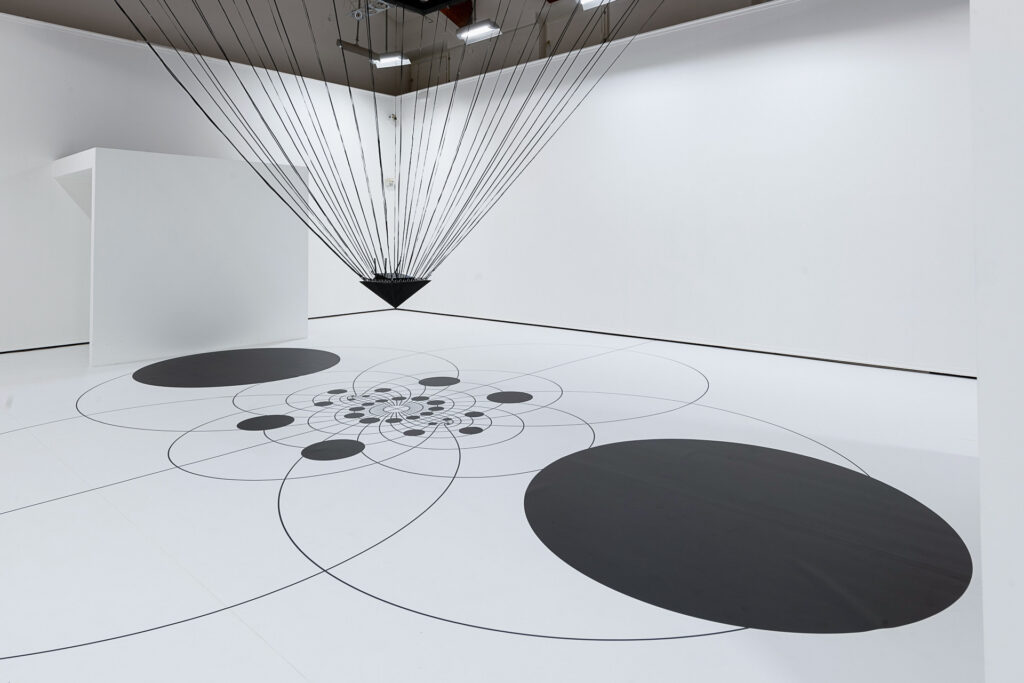
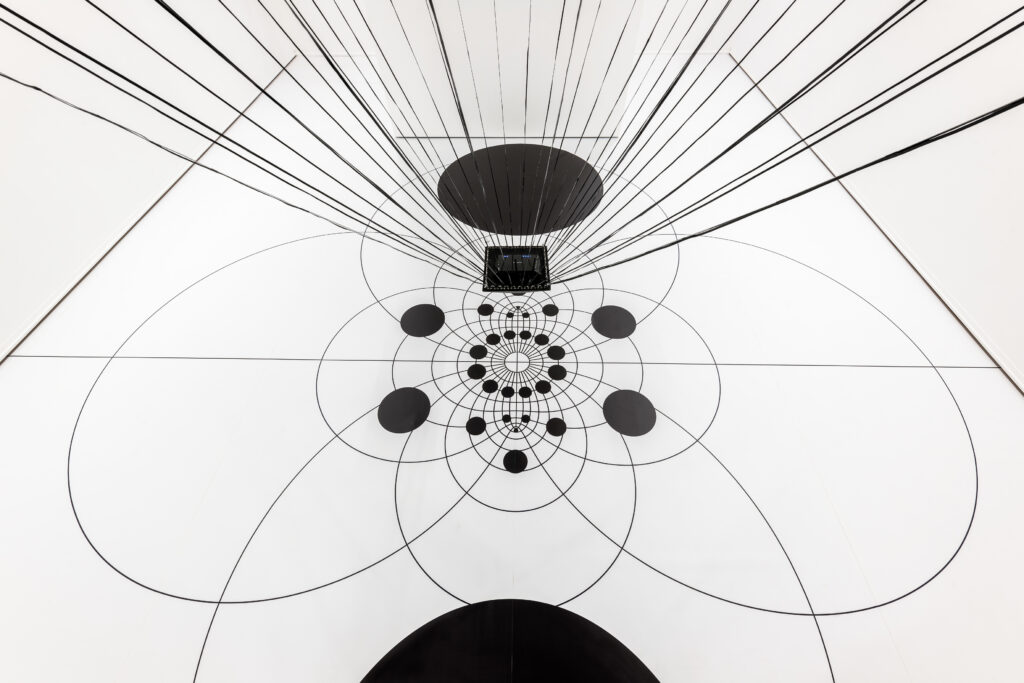
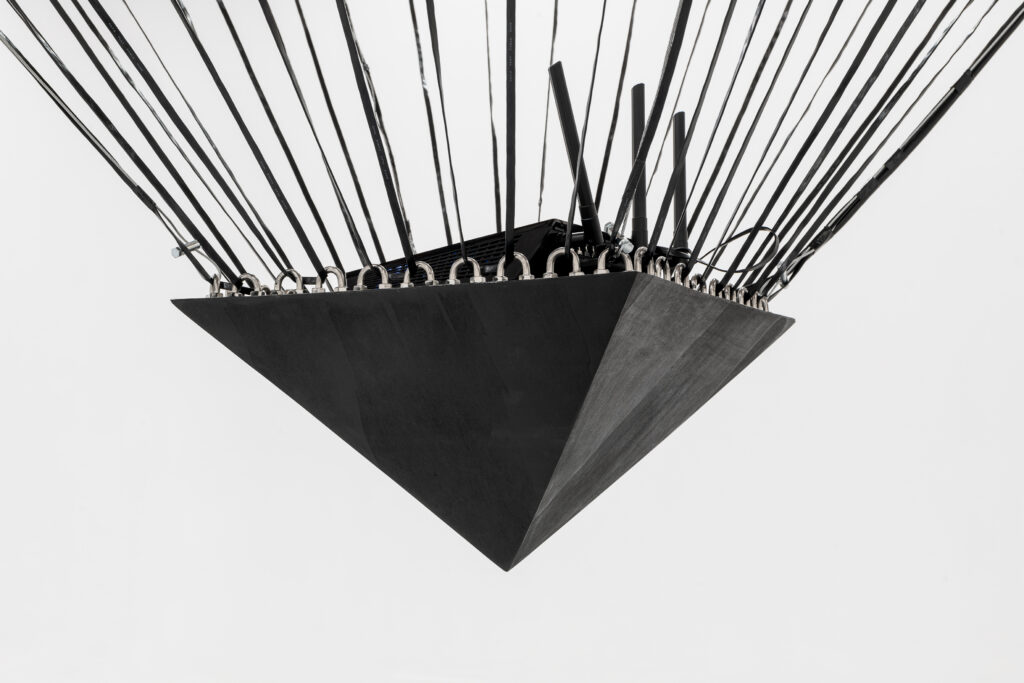
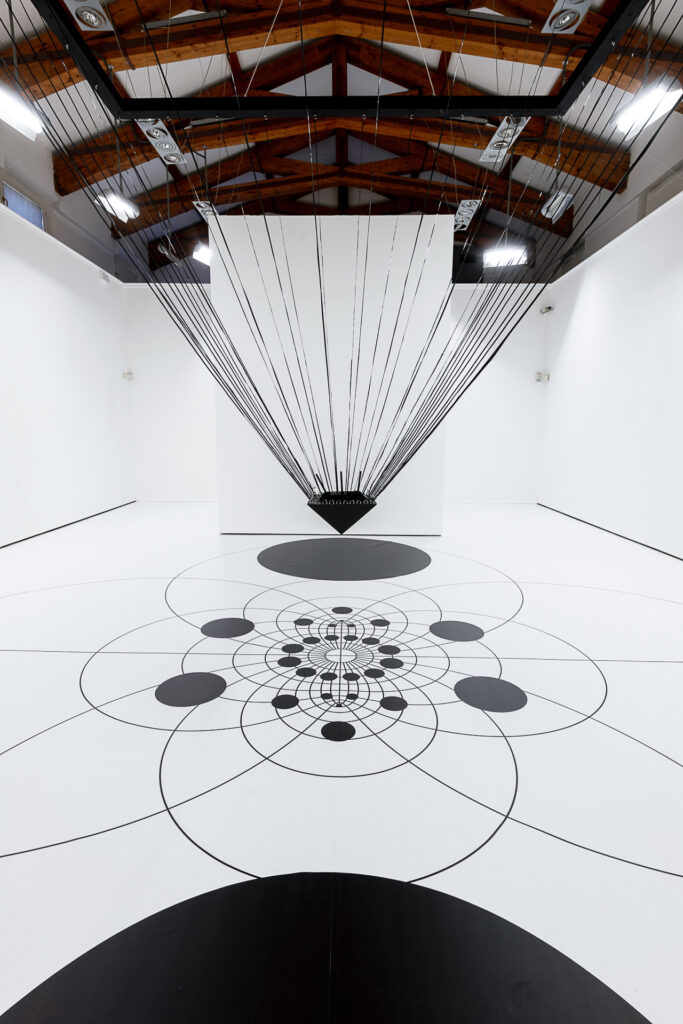
"The first work that lifts the curtain on the Mondi Distorti exhibition, created for the occasion and presented here for the first time, is “•••” [dot dot dot] (2023), an upside-down equilateral pyramid with a square base, made with a tangle of suspended Ethernet ca - bles that converge towards the tip containing a wi-fi router. Visitors are invited to connect to the “•••” wi-fi network to navigate the web and transmit data through the pyramid. Once connected to the “•••” wi-fi network, any data sent, e.g., a message or a photo of the installation itself, would travel through the network cables com - posing the pyramid. The pyramid image is a nod to both the Kopimi logo and the radio antenna erected by Guglielmo Marconi in 1901 in Poldhu, Cornwall, as a wireless telegraphy transmission station. It was from here that the first transoceanic radio signal – three dots in the Morse alphabet, representing the letter S – was sent. Before the advent of the Internet, radio was perhaps the freest and most effective global means of communication for both public and private communications. For almost a century, radio was used for official communications, but was also a free source of information, suffice it to think of the role of the BBC radio broadcasts during the Second World War or the amateur radio network. Roth’s pyramid, unlike Mar - coni’s, transmits an Internet signal. What do the two signals, both invisible but capable of transmitting data around the world, have in common? The fact that they both use the electromagnetic spectrum. How are they different? Radio signal transmission infrastructures are extremely visible; Internet infrastructures are almost invisible. Radio technology is simple enough that anyone can set up and own their own transmitter. On the Internet we can create our own site, but we are all users of a technological system owned by a few multi - national corporations.
The work, created in 2023, is a summation of the concepts dear to Evan Roth. These same concepts, namely trying to understand how the communications system works in order to prompt a critical con - sciousness towards it and perceive its distortions, are also at the ba - sis of his other works on show. In a 2016 interview Evan Roth states: “Radio, which, at the time, might have seemed even more magical and powerful than the Internet did to our generation, only had a 10- year heyday before the introduction of television (which essentially replaced it). With this in mind, it doesn’t seem so far-fetched to me that some fundamental change to the Internet, or new form of communication along the spectrum, could happen within our lifetimes. This is one of the reasons I’m so obsessed with the electromagnetic spectrum at the moment. I love the idea that whether we are communicating with visual light (painting), IR (fiber optic), microwaves (wifi/cellular) or VHF/UHF (radio and TV), it is all happening on a single spectrum differentiated only by the distance between peaks of waves. When I look at [spectrum diagrams], I get excited because I know the answer to many of the problems with our current communication structures are [sic] there. This is one reason why you see the spectrum range (from visible light to near infrared to radio) showing up in [my] work in various ways. […] The height of radio towers is often dictated not by line of site issues, but by the length of the EM wave they are interested in transmitting and receiving. The antennas you see spotting the landscape are typically ¼ or ½ the length of the actual wave they are built to transmit. The former architect in me sees this as one of the most poetic relationships between form and function in the built environment.”1 In the Landscapes project, which is also present in the exhibition and we will talk about later, Roth worked at length on the invisibility of Internet cable networks."
~ Chiara Dall’Olio from the Mondi Distorti Catalog
Exhibited
- Fondazione Modena Arti Visive, Mondi distorti, Modena, Italy, 2023
Related Media
- Mondi Distorti Catalog, texts by Chiara Dall’Olio and Nadim Samman, 2023 (pdf)